Showing posts with label guest posts. Show all posts

Wednesday, 25 September 2013

8

Handmade Costume Series: Minecraft Jamie

Inevitably, it's that time of the year where we're starting to think about our Halloween costumes.  Technically speaking I would've commenced the actual costume-labour the day before Halloween much closer to the end of October but I'm up on The Train To Crazy's Handmade Costume Series today!

Minecraft Cover Photo 750

Despite applying extreme pressure on the kids to chose a Doctor Who theme for which I could sew (I will never forgive Maia for turning down the Sister of Plenitude Cat Nurse), they had their hearts set on Minecraft Costumes.  If you don't have children or know children, you might be unfamiliar with Minecraft and I am currently jealous of you.  Jamie is obsessed, all of his friends are obsessed, Maia is working on it.

minecraft background

I couldn't find any conceivable way that I'd be able to utilise an actual skill of mine like sewing, so I was forced to deploy other crafting techniques (I hesitate to call them skills) of painting and 3-D construction.  The good news is that Minecraft is a 16 bit game designed to look heavily pixelated with all straight edges so it was fairly straightforward to replicate.


What you need  (a lot of these are do as I say, not as I do):
  • White heavy paper (I used normal printer-weight and would definitely recommend something heavier so it doesn't wrinkle from the paint) 
  • Cardboard to make the box (I salvaged corrugated cardboard as that's what I had to hand but I would definitely recommend choosing something with a smoother surface)
  • Paint (I used brown, black, white, red, peach, and yellow acrylics)
  • Ruler and pencil
  • Adhesive to fix your paper to your cardboard
  • Tape to form your box

minecraft 1

I wanted to concentrate most of my efforts on the front view so I Google image-searched and used this larger file for the basis of just the face.  I blew it up and printed it on glossy paper so I'd have a big visual reference and also somewhere to get the shades correct before committing it to paper.  Counting the pixels the face is 8x8 so I decided to use a 1.5" grid to yield a 12"x12" box.  Using a ruler I made the grid on my paper five times (front face, side left, side right, back head, and top head).  What I didn't do (but wish I had) was to add a margin of half an inch around all edges of the grid so it would be easier to wrap continuously around the box.

Minecraft 2

I started with a colour I already had and tested it right on the photo to make sure there was a colour-match  before committing it to the grid.

Minecraft 3

Once I'd exhausted the straight matches, I started mixing colours together on a palette to form the rest.  If you're attempting your own Minecraft Steve and following my advice to add margins along the edges, extend the paint on the border cells that extra half inch.

Minecraft 4

Keep on mixing paints and in four short hours, you'll have something like this (but with borders, because you're cleverer than me).  After the front was down it's time to do the remaining four sides, which thankfully are a lot less work.  I'd tracked down a different file for the remaining panels, printed that out on a much smaller scale and set to work on painting the rest.

minecraft 5

After all the panels are complete, leave the paint to dry (or stay up all night depending on your time-scale).  Once dry, cut five 12"x12" pieces of board and them together at the edges like so:

minecraft 6

Then fold the panels in to form a cube.  Use your adhesive of choice to attach the painted panels to the corresponding sides of the cube (told you those borders would come in handy).  And you're done!  Find an addict and make him stand in the garden at dawn for reasons-confusing-to-the-neighbours.

Minecraft Collage 2

Make it up to him by superimposing his Minecraft avatar into a screenshot of one of his very own servers.  Before you ask, nope, I haven't dealt with the eye holes yet.  This box is going to go on top of a body box closer to Halloween so I need to wait to see at what level his eyes are sitting at.


Thanks for having me, Andrea, and make sure you check out the rest of the series!

Sunday, 2 June 2013

17

Tutorial: Yoked Knit Sundress for the '30 Days of Sundresses Series'


I'm super excited to share a new dress design today as part of the Melly Sews '30 Days of Sundresses' series.  A whole month of sundress tutorials for girls and women from a huge crop of talented bloggers!


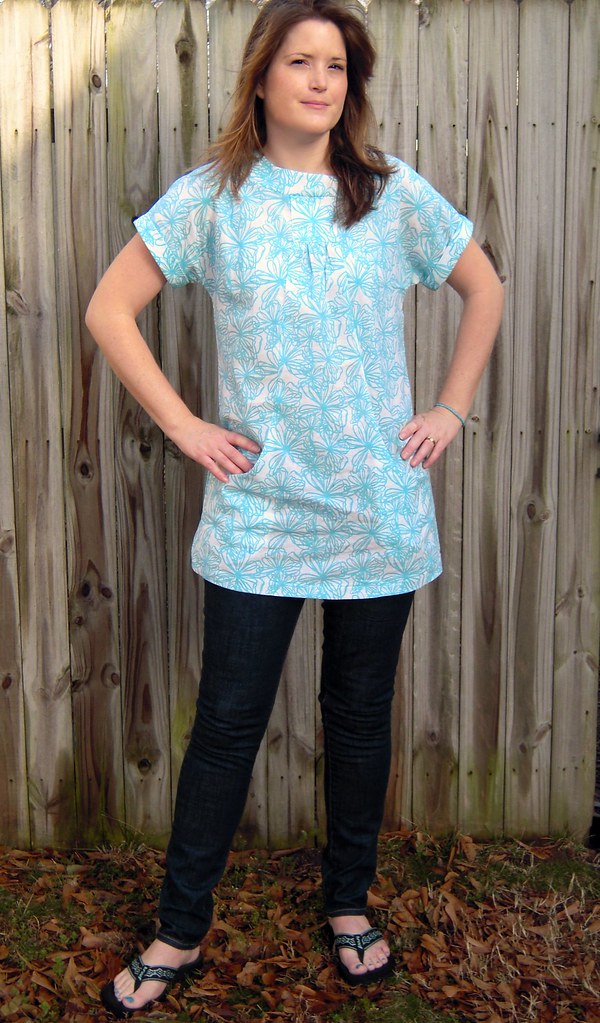
Illustrious company, eh?  At least I'm going at the beginning so my oh-my-god-how-can-I-top-that levels are relatively low.  I say relatively low as this post is following Andrea's, who made a super cute Easy Wrap Tunic!  So what am I bringing to the table?


This tutorial will show you how to adapt a knit tank pattern (or a t-shirt if you prefer- I haven't added sleeves but the principle is the same!) into a yoked dress with contrast trim.  If you don't have a pattern that you like you can always trace one off an existing garment.  The bits you'll need are the bodice section through the armholes; I'm using my skater dress pattern because I'm nothing if not predictable.

1 starting pattern

Trace out your bodice piece from the neckline through to the arm curve.

 2 draw yoke

First, draw a curved line from a point about half way down your armhole to the centre front fold.  This becomes your stitch line.  I used my french curve to do this; where it hits at centre front should be at a right angle.

3 add seam allowance above

Then draw a seam allowance line above this curve.  The original curve line in black becomes your stitch line.

4 draft dress

To make an a-line dress I extended from the armpit down to dress length at an a-line angle, and then a gentle curve to the centre front.

6 add sa back

Using a separate piece of paper, trace the upper bodice section and add the seam allowance below the curve.  This is your yoke.  As above, the black curve line is your stitch line.

8 front pieces

Cut both along the seam allowance lines.  You'll now have two pieces; the upper bodice and the main body of the dress.  The upper bodice has the seam allowance below, the lower section has the seam allowance above.

8 trace back

Use your yoke piece to draft the back piece.  It should be identical to the front piece except for the neckline.

10 pieces cut

Now you have three pieces: front bodice top, back bodice top, and two identical lower portions.  The lower portion will be cut twice for both the front and back.  Cut out your pieces.

11 sew yoke back

For the back, I did a simple join between the upper and lower pieces without a trim.  Right sides facing, match centre back of the upper and lower pieces and pin along the curve.  You will find that there is a triangular wedge of the lower portion that will hang over the edge of the yoke, this is because you are aligning stitch lines rather than edges.  Once sewn and pressed toward the top, the wedge disappears and the arm curve is nice and smooth.  

12 follow curve

Sew along the edge carefully and following the curve.

13 press to top

Press seam allowance towards the top. Wedge gone!

14 topstitch sa

Topstich the seam allowance to the upper bodice. I use a 3.2 stitch length to avoid the stitch breaking from stretching.

15 topstitching done

All done with the back, set aside.

16 baste trim

For the front I added a contrast trim between the yoke.  I used a strip of fabric (pressed on the fold) of the same height of my neck band for uniformity.  Rather than measure a precise length of trim, I sewed a strip on using gentle stretching so that it followed the curve and then I trimmed back to the original piece afterwards.

 17 trim excess

Baste the trim to your lower section within the seam allowance, pulling the trim only ever so gently.

18 trim excess

Trim away the excess.

19 press front

Now sew on the yoke as you did the back of the dress.  Press towards the top with all your might.  The contrast strip will try its best to flip up.  Press the bejesus out of it so that the seam allowance is facing up but the contrast strip is facing down.

20 topstitching

Topstitch the seam allowance to the upper bodice. Then topstitch the strip to the lower section, very close to the edge.  Again, I use a 3.2 stitch length to avoid the stitch breaking from stretching.

21 front done

Finally, sew up the rest of the dress as you would normally do.  For me (as I prefer to sew in neckbands and armbands in the flat) the process is: sew one shoulder, sew neckband, sew other shoulder, sew both arm trims, sew side seams, and hem. You're done!

snow white yoked sundress full 2

Thanks very much for having me, Melissa!

  GoTo Sew Kitschy Coo Occasionally Crafty Naptime Crafters Sew Country Chick You and Mie Flamingo Toes Googiemama Delia Creates Melly Sews The Mother Huddle sewVery Alida Makes Sugar Bee Crafts Seamingly Smitten Boy, Oh Boy, Oh Boy! Sumo's Sweet Stuff Craftiness is Not Optional Elegance & Elephants Sew A Straight Line Kojo Designs Caila Made Family Ever After Mama Says Sew Simple Simon & Co. Little Kids Grow A Couple of Craft Addicts Image Map

Friday, 22 February 2013

9

The Joker Dress

Guess what? Today I'm guest-posting over on Me Sew Crazy for the fabulous KIDS series!

Joker Dress Cover 

Trying to wrap your noggin around what prompted me to make such a crazy dress? Click on through for the full story...

Saturday, 17 March 2012

6

Make it in a metre series: The Sandbridge Set

We've got another great guest poster in the Make In in a Metre Series, Cindy from Siestas and Sewing! Cindy has four kids to sew for, and does some nifty clothes for herself too:


I know. I don't believe she has four kids either. As well as very kindly agreeing to guest post, Cindy has also provided tutorials and patterns for what she made! Introducing The Sandbridge Set.....

___________________________________________________________________

sandbridge set MG

I was super excited when Amanda asked me to share a little about my experiences with knit sewing and to do a project. It just so happened that I'd been kicking around the idea of drafting a shorts and top pattern for my little girls who are almost 7 and 5. Their usual summer "uniform" is a knit top and shorts...clothes perfect for 2 very active little girls. Taking a pair of Old Navy shorts they wore last year and a favorite Gymboree top, I traced around the clothing and made my own pattern. Now, I'm not an expert on doing this. Most times, I work from an existing pattern and tweak it to suit my needs. There are several tutorials out there on how to draft patterns from clothing. Dana of Made has one
HERE. But if you know a little girl who fits in a 5/6, you're in luck!

Once you figure out what works for you and your machine, knits aren't scary. I have had some massive fails along the way but I've also discovered a few helpful tricks. Most of my knits sewing is done on my sewing machine since I don't have a serger. I use a stretch stitch (the one that looks like a lightening bolt) and a nifty stitch that seams and overlocks (my fave!):

2012-03-012

When I do use a straight stitch for topstitching, I lengthen it from 2.5 to 3. That's to help prevent the dreaded popped stitch. Keep in mind that most seams need to have a little give in knits. Nothing is worse than having your kid pull on a top and hearing the stitches pop!

Thread is important too. You will want to use a polyester or nylon thread as synthetic thread has a little give. For hemming, I either use a twin needle with wooly nylon (bulky nylon) hand wound on the bobbin--a trick I learned from Katie--or a faux cover stitch on my machine.

sandbridge set MG sitting

The Sandbridge top and shorts are named after a favorite beach of ours. We're a beach lovin' family and spend most of our summer hanging out in Sandbridge. The Sandbridge shorts are quick to make...especially if you leave off the pockets. There are all kinds of ways to change the look of the shorts.

sandbridge pockets

On the blue/white pair, I simply pressed up the hems and stitched with the twin needle.

OD top sandbridge shorts MG

But on the pink pair, I decided at the last minute to finish the leg openings with a contrast binding. You could gather the legs slightly before adding binding to get more of a bloomer look. Or one could make a slit on the outseam hem. The possibilities are endless!

sandbridge top BK

The top is a little more fiddly since you will be finishing the front/back necklines and armholes with binding. But the end results are worth it.:)


Sandbridge set BK

The Sandbridge top and shorts do not take much fabric. I was able to get 2 pairs of shorts and 2 tops from the metre of fabric Amanda graciously sent me. I also had enough scraps left over to dress up 2 Ottobre Design Raglan t-shirts (01/06 #17). Here's everything together!

018
022-001


Cindy has very graciously posted the patterns and tutes for the Sandbridge Top and Shorts in Google Docs. Links as follows:


Friday, 9 March 2012

4

Make it in a metre series: Piecing, colour-blocking, accenting and more

Following on from her original guest post on how to succesfully mix different knit fabrics into a single garment, let's find out what Katie actually managed to squeeze out of a metre of fabric...
___________________________________________________________________

My name is Katie and I blog over at Kadiddlehopper. I sew for myself, my 3 kids and on occasion, my hubby. We love the easy comfort of knit clothing of all varieties, and I love how fun knitted fabrics are to sew. Amanda was kind enough to send me a meter of the most amazing knit ever, and so I want to show you how to make a meter of a special fabric really go far. There are three strategies I tend to use:
  1. Piecing
  2. Colorblocking
  3. Special Accents
All three of these methods involve mixing fabrics that sometimes don't like to play together. Knits can be difficult to combine, but if you follow a few simple guidelines, they'll be no trouble at all.

Piecing

One of my favorite ways to make a special fabric really count is to piece it with solids or coordinating prints.

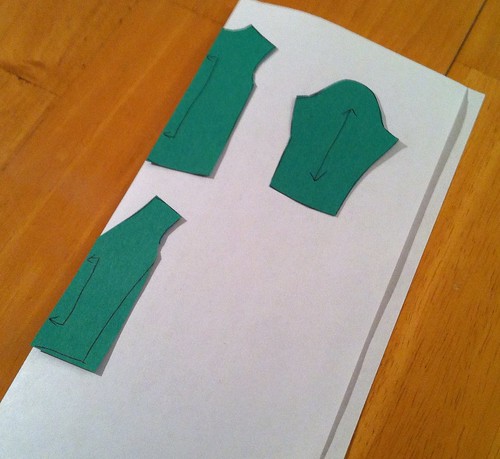
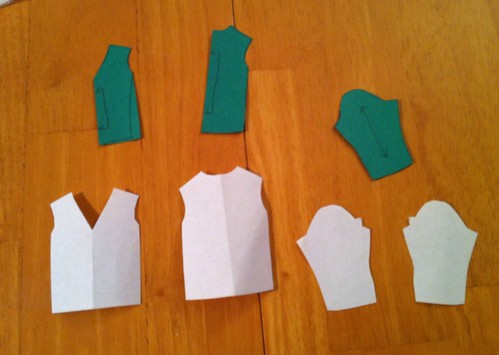
To make a pieced garment, start with a pattern that you already have. I'm using a raglan tee pattern from Ottobre (the 02/2006 issue), but you can draft your own with this great tutorial. First you have to make sure that your pattern is not cut "on the fold", so that you can lay it out in a single layer to cut up. I find the easiest way to make this happen is to treat your tracing paper as if it were fabric, fold it in half and cut out your pattern pieces, just as you would if they were fabric.

Now that you have your single layer pattern pieces, draw lines on them where you would like seams to be.

Cut them up once you like the way the piecing looks and you have your pattern!

Don't forget to add seam allowances to the cut edges when you cut out your fabric. When you are ready to sew, just reassemble the cut pieces to make whole pattern pieces and assemble your garment as usual.

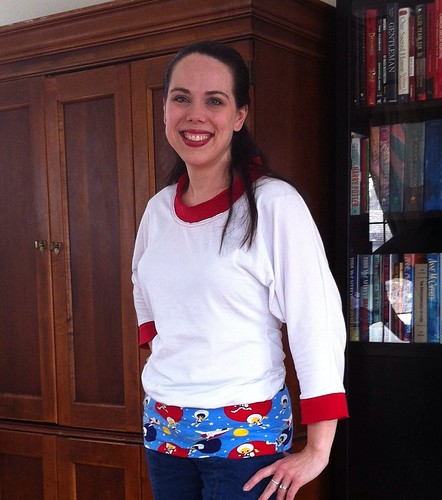
When I piece a garment, I like to use at least three different fabrics. My special fabric (generally a print), a neutral fabric (the white in this case) and a coordinating trim (print or solid - here I used red). I like to pick up a less dominant color in the color scheme for my coordinating color.

Colorblocking

This is a hot trend right now, so don't limit yourselves to just kids clothes for this one. Give it a try yourself!

Colorblocking is even easier than piecing, since there is no pattern manipulation involved. All you do is choose which pieces of the pattern you want for each fabric.

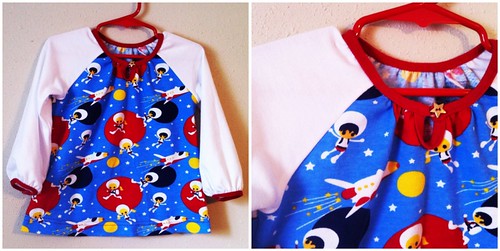
For Myra's tee, I used the print fabric for the body, white for the sleeves and red for the binding. As with piecing, I like to use a three color palette and to pick up an accent color from my special fabric.

Special Accents: Pockets, Patches and Applique

This method frequently uses small pieces, so you can use up every scrap of your precious fabric.

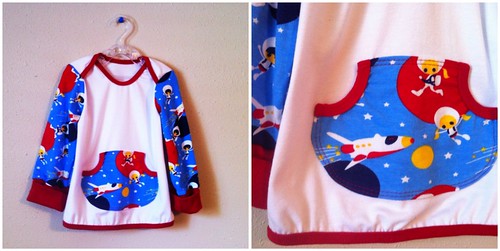
For Duncan's top, I used my print fabric to make a pocket in his envelope neckline tee. My pattern is from Ottobre, but you can use this tutorial to draft your own. I also colorblocked the sleeves with my print. You can use any of these methods together to personalize your item.


And then... Make Small Things:

After you've cut out your pieces and color blocked parts and appliques, use those little bits left to make little things. Millie outfitted her whole family with just a half meter!

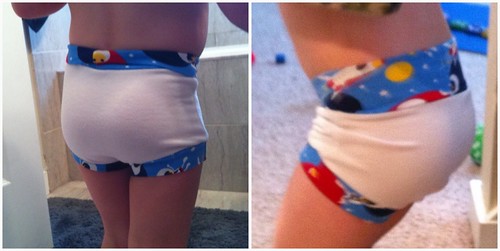
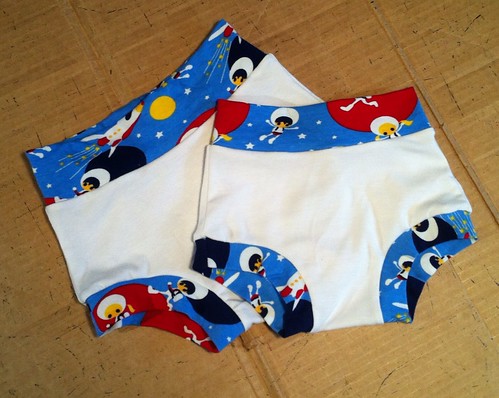
Underwear is such a perfect use up for small pieces of soft knit. I made mine coordinating, but you don't have to. Who's going to know?

My pattern is the Boy Brief Unisex Underwear pattern from Kitschy Coo. It is perfect for those little strips of fabric that I always end up with. As a bonus, this wonderful jersey has stretch in both directions, so I can cut my bands in whichever direction I happen to have fabric and they still stretch perfectly. Love that.

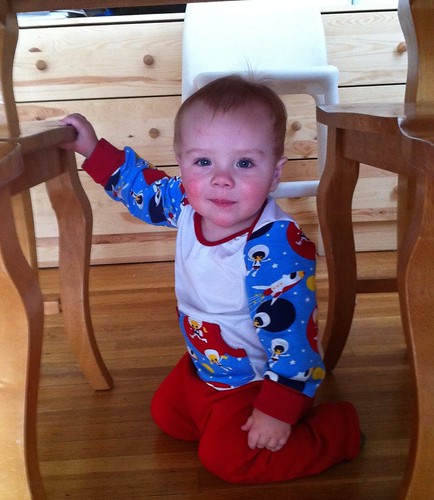
So the final tally? My one meter cut of absolutely fabulous blue astronaut jersey stretched (hah!) to make one adult dolman sleeve top, one size 6 raglan tee, one size 3 raglan tunic, one size 18 month envelope tee, two pair of underwear (size 5/6 and 3/4) and several appliques. And I still have a few scraps left. Enough for another pair of underwear and an applique or two. So, what can you squeeze out of a meter of fab fabric?